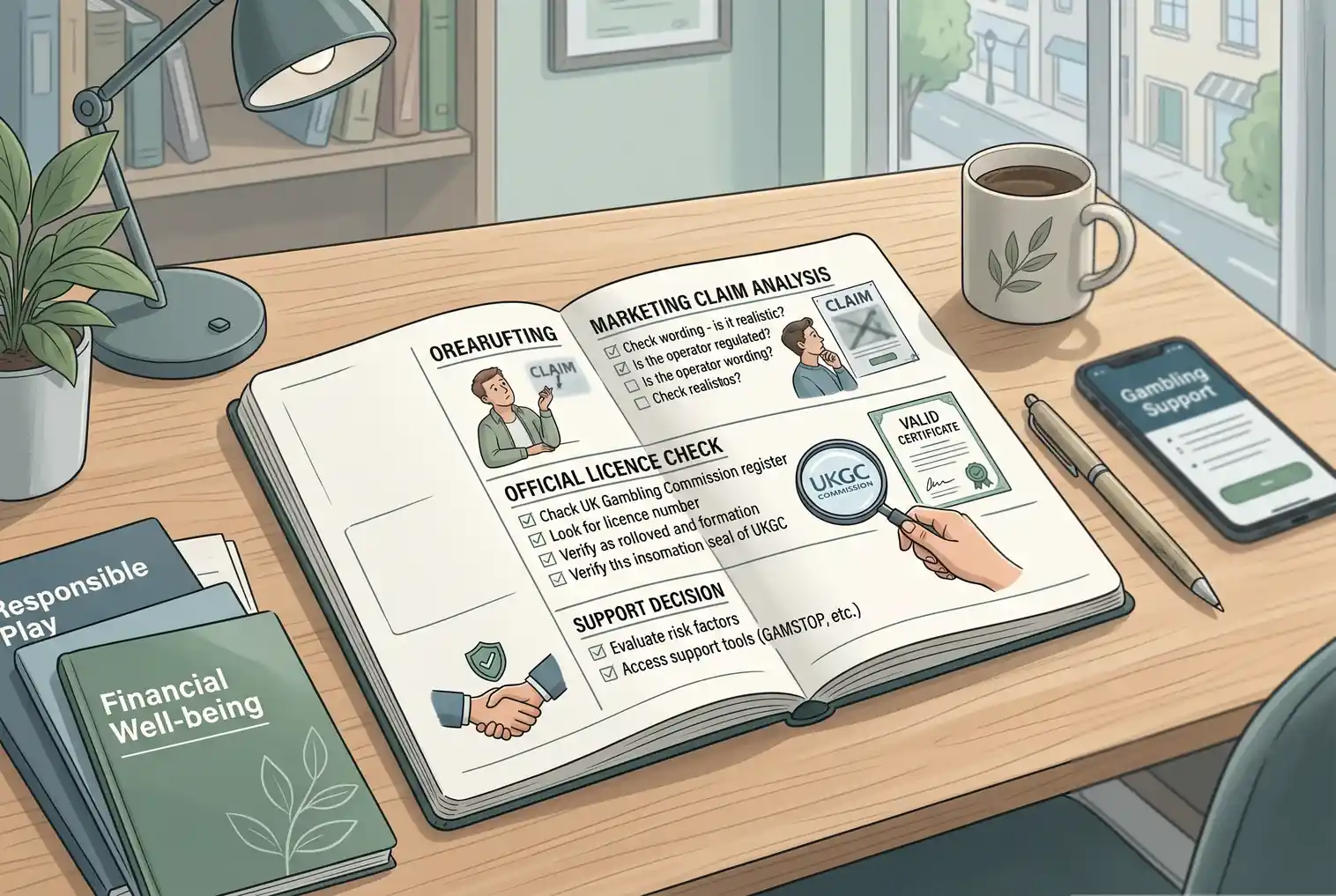
Verifying Casino Licences and Operator Domains in the UK
 Available in GB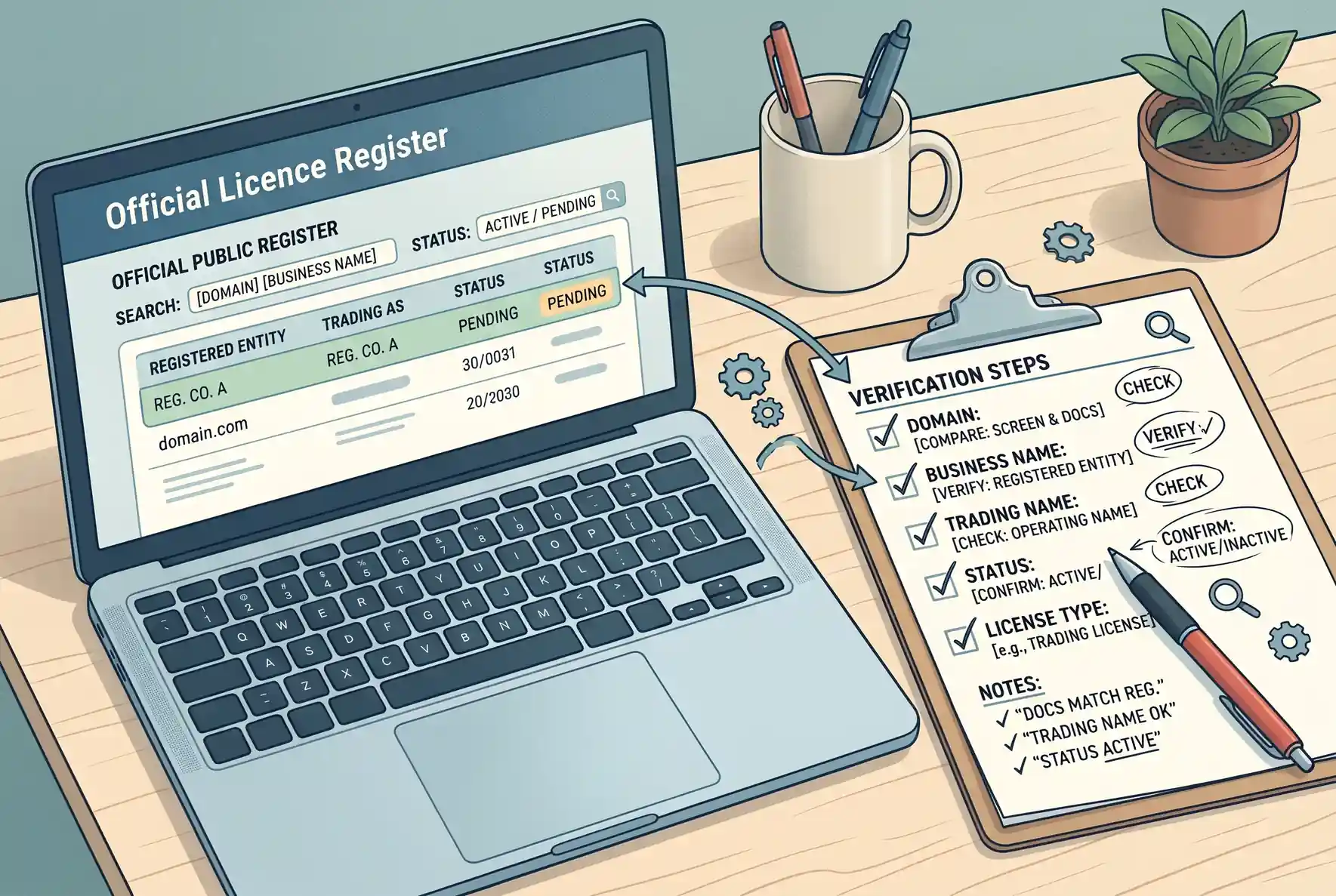
Validating Operator Domains on the Commission Register
Begin with the domain you are actually using. Do not shorten it in your head and do not assume that a similar-looking address belongs to the same licence. A small change in spelling, a different top-level ending, an extra word, or a redirect to another web address can matter. Copy the address from your browser and compare it with what appears in the official register entry.
If a site shows a company name, trading name or account number, write those details down before you search. Then check whether the official record connects the same details to the same web address. A trading name can differ from a legal business name, so one match is not always enough. You are looking for a consistent set of details, not a single familiar word.
Be especially careful with footer badges that are images rather than live links, with licence wording that does not mention the Gambling Commission when the claim is aimed at Great Britain, and with pages that describe themselves as “regulated” without saying by whom. A confident tone is not evidence.
Beyond verifying the operator’s credentials, you must carefully read the bonus conditions and customer-funds warnings before making your first deposit.
Licence-check checklist
| Check | What to compare | Why it matters |
|---|---|---|
| Exact domain | The web address in your browser against the web address listed in the public register. | A licence claim for one domain does not automatically cover a different or lookalike domain. |
| Business name | The legal business name shown on the site against the name in the register. | Some sites use trading names, so the business behind them still needs to match. |
| Trading name | The brand or trading name used publicly against listed trading names. | A familiar brand name without a matching record should not be treated as verified. |
| Status and notes | Current status, permissions and any register notes or regulatory-action information. | A record may contain important context beyond the existence of a name. |
| Terms location | The terms, complaints information and customer-funds wording on the site. | Even after a register match, you still need to understand the commercial conditions. |
How to read the result without overclaiming
A register match can answer a narrow question: whether the details you checked appear in an official record. It cannot answer every safety question. It does not guarantee that you personally can afford to gamble, that a bonus is worthwhile, that a withdrawal will be instant, or that a future dispute will end in your favour.
A failed or unclear match is also not something to explain away quickly. If the site claims to be licensed but the exact domain is not listed, the business name is different, the badge does not link to a recognisable official entry, or the wording relies on a licence from somewhere else while addressing Great Britain, pause. Do not deposit while trying to make the pieces fit.
Marketing can be polished. Some sites use words such as “trusted”, “secure”, “approved” or “licensed” in ways that are too broad to be useful. Your task is not to argue with the wording; it is to check what a regulator’s public record can actually confirm.
What the check cannot prove
- It cannot prove that a particular promotion is good value or easy to complete.
- It cannot prove that withdrawals will be paid by a specific date.
- It cannot prove that every term on the site is fair in every situation.
- It cannot prove that gambling is suitable for you, especially if you are self-excluded or under financial pressure.
- It cannot prove that your personal documents will never be queried or that account checks will be frictionless.
This is why a licence check should sit before, not instead of, a terms check. A site may have official details worth checking and still have conditions that you should read carefully before depositing.
Warning signs while checking
- The domain does not match. The register may show a different web address, or the site may use a related-looking name that is not the same address.
- The badge is only decorative. A logo or seal that does not lead to a clear official record should not be treated as confirmation.
- The licence wording is vague. Phrases such as “internationally licensed” or “fully regulated” need context. Who regulates it, and does that record cover the exact site?
- The terms are hard to find. If licence, complaints and customer-funds information are difficult to locate before deposit, that is a practical risk.
- The site pressures you to act before checking. Urgent promotions, countdowns and repeated sign-up prompts should not interrupt basic verification.
A careful register-check routine
Use a calm, repeatable routine. First, collect the exact domain, business name, trading name and any licence number presented by the site. Second, open the Gambling Commission public register directly rather than through an advert or review page. Third, search the details one by one and compare the result with the page you are using. Fourth, look for the status of the entry and any notes that change how you interpret it. Fifth, save what you found, especially if you may later need to complain.
If the details do not line up, do not fill the gap with hope. A mismatch is not a minor formatting issue until you have evidence that explains it. If the site is not clearly covered by an official record for the domain you are using, move away from deposit decisions and keep your money out of that account.
If the details do line up, continue to the next checks. Read the terms, payment restrictions, customer-funds wording, withdrawal conditions and complaints route. A licence record can make the next step worth taking; it should not make you skip the next step.
Where self-exclusion changes the answer
If you are checking a licence because you are trying to keep gambling despite self-exclusion, the safer answer is to stop the commercial check. A register entry is not permission to override a protection you put in place. The issue is no longer only whether a site can be verified; it is whether continuing to search is putting you at risk.
People often look for technical differences when the deeper problem is urgency, debt, shame or a feeling that one more deposit will fix the last one. In that situation, support, blocking tools and a conversation with someone you trust are more useful than another licence lookup.
Our comprehensive guide to non Gamstop casinos UK helps players understand the risks associated with offshore platforms.
Official and practical next steps
The official register is available at the Gambling Commission website. Use it directly when checking licence and domain details. For marketing claims, remember that gambling advertising is expected to be socially responsible and not to exploit vulnerable people. That principle is a useful lens: if a site’s message seems to turn self-exclusion into a selling point, be cautious.
After the register check, move to the money terms. Look at customer-funds wording, bonus restrictions, withdrawal limits, dormant-account rules and disclosed fees before any deposit. If a dispute has already happened, keep records and use the complaint path rather than relying on informal promises from a chat agent.