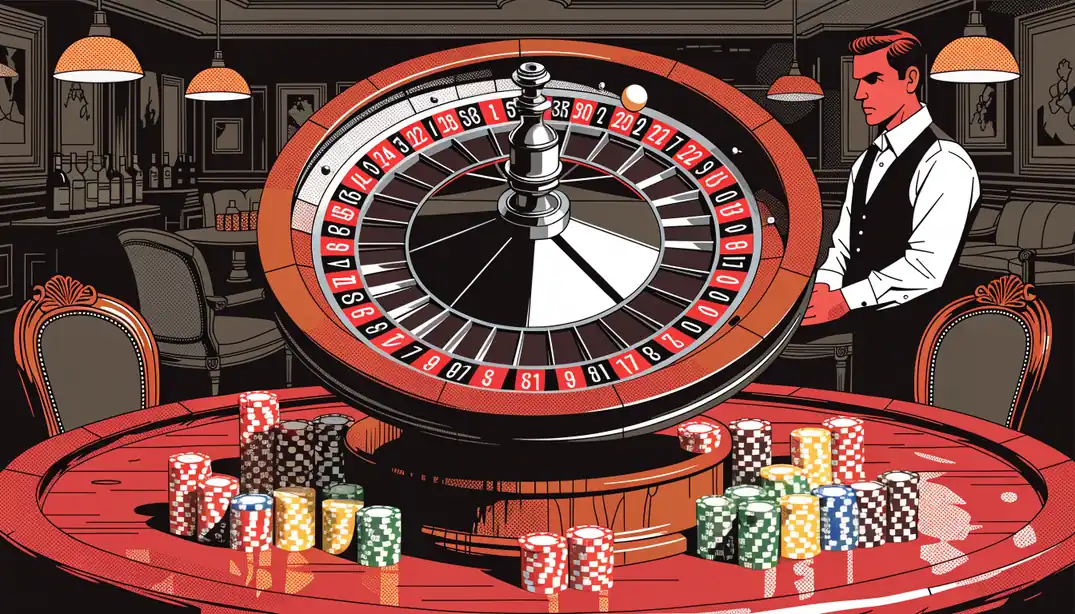
Live Roulette UK with English-Speaking Dealers
See how a physical roulette wheel, a live studio feed and the casino interface work together, and how that differs from automated roulette.
 Available in GB

Table of Contents
- How Live Roulette Works on a UK Casino Site
- From Studio to Screen: Playing Roulette Online
- Roulette Tables, Not Slot Games: Why the Rules Differ
- What the Live Dealer Adds to a Roulette Game
- Top online casinos in the UK
- What Makes a Roulette Casino Suitable for Live Play
- Deposits, Limits and the Cost of Playing
- Roulette Bonuses: Read the Conditions Before Counting the Value
- Trying Roulette Without Depositing
- Roulette Outcomes, Odds and the Limits of a Winning System
- Lightning Roulette and Other Live-Game Variants
How Live Roulette Works on a UK Casino Site
Live roulette combines the rules of a conventional roulette table with a real-time studio feed. The wheel is physical; a dealer sets it in motion and announces the result, while software carries the game to a player’s screen and records wagers through the casino interface. It is still roulette, not a video of a game that has already happened. Each round unfolds in the studio and is transmitted as it takes place.
That distinction matters because “live” describes how the game is presented and run, not a different way of determining the winning number. The ball lands on a pocket on the physical wheel. The interface displays the result and settles the round according to the wagers placed before betting closes. The screen is the connection between the table and the player, rather than the source of the wheel result.
Automated roulette works differently. In a digital version, software generates the outcome and presents it through an animated interface. There may be a wheel on screen, but no studio table or dealer is needed for each round. Live roulette puts a human-run table at the centre of the experience; automated roulette puts the game software there. Both are casino games, but the source and presentation of each round are not the same.
The studio is part of the game
A live table operates from a casino studio, where the wheel and table are positioned for the broadcast. The dealer runs the round, and the video feed gives the remote audience a view of the process. A casino’s interface and the studio feed work together: one carries the action, while the other provides the means to take part and shows the information needed to follow the round.
This arrangement is not simply a prerecorded performance with a roulette theme. The physical wheel is used for the live game, and the round is presented as it happens. The dealer’s actions provide visible continuity from one stage of the round to the next. The camera and interface make those actions legible to someone who is not in the room.
Mines Casino Game UK: How It Works and What to Know
From inside the industry, I see the attraction as a matter of format. A digital game can move straight from one generated result to the next; a live table has a person, a wheel and a broadcast rhythm. That does not make one format more favourable than the other. It changes what the player sees while the game is running.
The studio also explains why live roulette is offered as part of a broader online casino rather than as a separate kind of gambling. The operator provides access to casino games; the studio supplies the live table presentation. Grosvenor, for instance, first introduced live casino games in 2013, with roulette alongside card games such as blackjack and Texas Hold’em. It was an early example of a familiar casino format being brought to an online audience, not a change to roulette’s basic identity.
The casino provides the route to the table
A roulette casino UK customers use is more than a page showing a wheel. The casino account and game interface provide the route into the live table, while the studio supplies the game feed. In practice, the two parts may feel like a single product, but they have different jobs: the casino makes the game available through its site, and the live studio runs the table that appears on screen.
For Great Britain, there is a legal boundary around that route. Remote operators serving consumers in Great Britain must hold the relevant Gambling Commission licence. That requirement applies to the operator offering the gambling service, not to the physical location of a studio or other equipment. The online setting does not remove the operator’s responsibility to be licensed for the market it serves.
A UK roulette casino should therefore be understood as a licensed online gambling service offering roulette to customers in Britain, rather than as a studio with a British address. The wheel can be elsewhere; the relevant question is whether the operator serving the player holds the required licence. That is the market context behind live roulette online.
Live roulette is a description of the delivery format: a physical table, a live broadcast and an interface for participating. The casino site provides access and the software connects the player to the live studio.
There is no need to treat “live” as a guarantee of greater fairness, better value or a more personal relationship with the dealer. It is a description of the delivery format: a physical table, a live broadcast and an interface for participating. The dealer runs the table; the casino site provides access; the software connects the two.
That is the basic arrangement. The wheel remains physical, the presentation is live, and the online casino is the channel through which the game is offered.
From Studio to Screen: Playing Roulette Online
Opening a live roulette table is a small sequence of decisions, not just a video loading on a page. The lobby presents tables as separate choices; after selecting one, the screen typically brings together the dealer’s feed, the betting layout and information about the round. Those elements have different jobs. The video shows the physical table, while the controls let the player place wagers and follow the game state.
I have found that the useful question is not whether an interface looks polished, but whether it makes the current stage of the round clear. A live table has a cycle: betting opens, wagers are entered, betting closes, the wheel is spun, and the result is shown. The interface needs to communicate where the round is in that cycle. If the countdown, betting controls and dealer feed appear to disagree, it becomes harder to tell whether a wager has registered or whether the next round has begun.
Online Casino Without ID in the UK: What to Expect
Joining a table
From the lobby, a player chooses a table and waits for its stream and controls to load. The table view may show the dealer and wheel prominently, with the betting layout alongside or below. On a smaller screen, the layout can shift, so the same controls may occupy a different part of the display. It is worth taking a moment to locate the chip values, the betting positions, the clear or undo control, and the round status before entering a wager.
The live feed and the betting panel are connected, but they are not the same thing. The feed is a video presentation; the panel is the part of the casino interface through which the wager is submitted. A visible chip on a betting position is useful confirmation, but the interface should also make it clear whether the selection was accepted for that round. A player who taps while betting is closing should not assume that a wager has gone through merely because the action was attempted.
This is one place where online roulette differs from watching a video. The player is interacting with a timed game interface, not simply viewing a stream. The display has to show both what is happening at the table and what actions remain available.
Placing a wager and following the round
When betting is open, the layout represents the roulette betting positions. The player selects a chip value, then taps or clicks the position where it should be placed. Several selections can be made before the round closes, subject to the table’s controls. Depending on the interface, the player may be able to repeat the previous wager or remove a selection before betting ends. Those controls are conveniences, not substitutes for checking the layout: an accidental repeat can be just as consequential as an accidental new selection.
Joining a table
- Locate the chip values
- Find the betting positions
- Locate the clear or undo control
- Check the current round status
Once betting closes, the interface should signal that no further wagers can be placed for that round. The dealer then spins the wheel, and the camera follows the physical play. A result panel or marker identifies the winning outcome after the ball settles. The betting layout may then show which positions corresponded to that result and how the round was settled. The sequence is easier to follow when the video and on-screen state changes are readable at a glance.
I pay particular attention to whether the interface distinguishes a placed wager from a settled result. A chip remaining on the layout after the wheel has spun does not itself explain the outcome; the result display does that. If a game offers a history panel, it records previous results for reference, but it does not change the next round or make a particular outcome more likely.
What the screen is doing
The interface is a working layer between the table and the player. It carries the available actions, records the selections and presents the result. The studio feed adds the visible dealer and physical wheel, but the screen still has to make the game legible: current round, open or closed betting, accepted wagers and settled result. That is more important than decorative graphics.
Connection quality also affects the experience. A delayed or interrupted stream can make the visual action feel out of step with the controls. The sensible response is to rely on the table’s displayed status rather than infer the round from a moment of video alone. If the interface indicates that a wager was not accepted, the camera view cannot reverse that. If the screen freezes or the round state is unclear, pausing before making another selection avoids compounding confusion.
Online Casino American Roulette UK: Wheel and Play
The casino lobby and table screen serve different purposes. The lobby helps locate a live roulette game; the table view supports play once it has been opened. In the UK, online casino activity falls within the Gambling Commission’s remit. Its regulation of remote gambling offered to people in Great Britain applies regardless of where the operator’s key equipment is located; the Commission is the sole regulator for commercial gambling in Great Britain and issues operating licences to businesses, as well as personal licences to individuals working in the sector.
That regulatory context does not tell a player how a particular table interface behaves. The practical test is on screen: can the stages of a round be followed, can a wager’s status be seen, and is the result presented clearly? If those basics are obscured, a dramatic studio set will not make the table easier to use.
Live roulette works best as a sequence that can be read: choose the table, understand the layout, place the wager while betting is open, then follow the result. No mystery.
Roulette Tables, Not Slot Games: Why the Rules Differ
Roulette and online slots can sit beside each other in a casino lobby, but they are different game categories. Roulette is a table game: wagers are placed on a wheel outcome under the table’s rules. A slot game runs through its own game cycle. That distinction matters when comparing the rules that apply to each.
Attention UK online slot stake limits (such as £5 per cycle) apply specifically to slots and do not include roulette or blackjack.
A specialist review reports that Great Britain’s online slot stake limits set a maximum of £5 per game cycle for players aged 25 or over, and £2 for those aged 18 to 24. The limits concern online slots, not every casino game. The same review states that roulette and blackjack are outside those slot-specific caps. Those figures should be read in that context, rather than treated as a general limit on roulette wagers.
The category is not just a label in a menu. Slot rules are designed around the way a slot game advances from one cycle to the next. Roulette has a different structure: the player places wagers on a table, and the round resolves around the wheel. Applying a slot stake cap to roulette would blur two separate formats and misstate what the rule covers.
That does not make roulette unregulated. Gambling regulation still applies to the operator and the service; the narrower point is that a rule written for online slots does not automatically extend to table games. In my experience, this is where casino comparisons can get muddled: a headline about a “stake limit” sounds universal, while the actual rule may attach to one specific type of game. Read the category carefully.
Slot rules are not roulette rules
Other requirements may also be tied to slots rather than casino play as a whole. For instance, Britain’s online slot autoplay ban and the minimum time between slot game cycles concern slot mechanics. They should not be presented as roulette rules. Roulette has its own table format and round sequence, so the relevant question is always which game the requirement names.
Online European Roulette in the UK: Rules and Odds
This distinction is useful when comparing roulette casino sites in the UK. A site may offer slots, roulette and other table games under the same account, but sharing a lobby does not make their rules interchangeable. A “top” or “best” label in a comparison does not change the legal category of the game either. The slot cap is not a measure of whether a roulette table is suitable, nor does it tell anything about the quality of the casino’s live presentation.
For a live roulette casino site, the same distinction applies: the fact that a wheel is shown through a live stream does not turn roulette into a slot. It remains a table game, even when the interface displays the wheel and betting layout on screen. The delivery method and the game category are separate things.
I would treat any explanation that uses slot limits as though they cover every game with the same caution as an advert calling a product “simple”. The wording may be neat; the scope is narrower. Roulette remains outside those particular slot caps, while the operator’s wider obligations remain a separate matter. Category first. Then the rule.
What the Live Dealer Adds to a Roulette Game
A live dealer gives roulette a human-led pace. The dealer presents the wheel and ball, starts each round and announces the result, while the game interface handles the wager and displays the table state. That division is the point: the game is still roulette, but its events are presented as they happen rather than generated entirely by software.
Software Roulette
An automated version where software generates the outcome and presents it through an animated interface.
Live Roulette
A human-run table where a physical wheel is set in motion by a dealer in a studio.
I find the distinction easiest to see in the moments between wagers. In a digital roulette game, the software controls the sequence from one round to the next. At a live table, the dealer’s actions mark that sequence: the wheel is set in motion, the ball travels, and the result is declared. The presentation can make the round feel more like a hosted table game, though it does not change the underlying fact that each spin is an independent game event.
The dealer also gives the table a visible source of information. A result is not only a number displayed on a screen; it is shown in the live presentation and then recorded by the interface. That can help make the sequence easier to follow. It is not a guarantee against errors or a signal about what the next result will be. A human host adds context, not predictive insight.
There is a practical limit to the role. The dealer does not decide where the ball lands, alter the game’s rules for an individual player or improve the chances attached to a wager. The wheel outcome determines the result. The host’s job is to conduct the round, keep its stages clear and announce what has happened. The theatre sits around the mechanics.
That matters when comparing a live roulette table with a digital version. Software-only roulette moves through a simulated presentation; live roulette shows a dealer operating a physical table through a streamed feed. The difference is mainly in how the game is presented and paced. The betting choices and settlement remain part of the game interface, while the dealer supplies the human performance.
Live Baccarat Online Casino UK: How It Works
A live host can also make the table feel less anonymous. There is a person on screen, a spoken announcement and a shared rhythm to each round. That can be appealing to players who prefer a hosted casino game to a purely digital one. But it should not be mistaken for personal attention at every moment: the dealer is conducting a table, not providing private coaching or advice on what to wager.
The format has a history in the UK casino market. Grosvenor introduced live casino games in 2013, with a selection that included Blackjack, Texas Hold’em and Roulette. That early mix shows how live casino was framed as a way to bring familiar table games into a hosted online format, rather than as a new set of rules.
In my experience, the useful way to judge the dealer’s contribution is modestly. A live host makes the round legible and gives it a human presence. The host does not make roulette more predictable, and a polished presentation is not evidence of better returns. The substance is still the wheel, the wager and the result.
Human presence. Same uncertainty.
Top online casinos in the UK
- AmunbetBonus: Join now and get 450% up to 2,700 GBP + 450 FS · Payout speed: 1-3 business days
- Revery PlayBonus: 100% up to€1,000+ 100 FS · Payout speed: 1-3 business days
- SpinFormulaBonus: 550% Up To £15,000 + 550 FS · Payout speed: 1-3 business days
- BeOnBetBonus: 100% up to €500 + 100 FS · Payout speed: 1-3 business days
- SlotoSportBonus: 500% up to £ 10 200+ 777 FS · Payout speed: 1-3 business days
- EvoSpinBonus: 125% up to €2500 + 125 Free Spins · Payout speed: 1-3 business days
- ZombillionBonus: Welcome Pack 250% up to £4000 + 200 FS · Payout speed: 1-3 business days
What Makes a Roulette Casino Suitable for Live Play
A “best” live roulette casino is not a universal category. I have found it more useful to separate the claims on a casino’s landing page from checks that can be made independently. The first and most important is whether the operator is authorised to serve customers in Great Britain.
Do
- Verify the operator’s licence on the Gambling Commission register
- Check that the site identity matches the licensed business
- Confirm the table rules and limits before play
Don’t
- Rely on promotional labels like “premium” or “exclusive”
- Assume a branded table offers better odds
- Trust a headline without reading the full terms
The Gambling Commission requires remote gambling operators serving Great Britain to hold the relevant licence. Its public register is the place to verify that status before depositing. Search for the operator’s legal name and check that the licence covers the business and the domain being used; a familiar brand name alone is not enough. If the register does not match the operator or site, stop there. A polished studio presentation cannot make up for a missing licence.
Check the operator, not the sales language
Casino pages often describe a table as “premium” or “exclusive”. Those are promotional labels, not evidence of suitability. I would look instead for a clear link between the casino brand, the licensed business and the web address, then check that the live roulette offering is presented within that licensed account. If those details are hard to find or do not agree, the uncertainty is material.
A licence is a threshold check, not a promise that every table will suit every player. After confirming it, compare the information the operator actually provides: the roulette format, the table’s published rules, any stated minimum or maximum wager, and whether the rules are accessible before play. These are practical details, not a ranking. A table’s limits can affect whether it fits a player’s intended stake; they do not establish that its odds are better.
Separate odds from presentation
The phrase “best odds” is often used as if it described the casino rather than the game. I would check the rules for the particular roulette table and avoid treating studio design, dealer style or an advertised strategy as evidence of a more favourable outcome. A casino can make the rules easy to locate; it cannot turn a presentation claim into proof of better odds.
Online Casino Tournaments in the UK: Formats and Terms
The same distinction applies to strategy. A site may explain how to place wagers, but no casino label makes a roulette strategy reliable or guarantees a result. I have seen promotional copy blur those points. Read the rules; ignore the implication that a branded table changes what a wager can achieve.
A useful comparison is therefore a set of verifiable questions: does the public register support the operator’s claim to serve Great Britain, does the site identity match the licensed business, and can the table rules and limits be checked before play? If any answer is unclear, another casino is easier to assess. No need to dress it up.
Deposits, Limits and the Cost of Playing
A live roulette account involves more than choosing a table and placing a wager. Before a customer can deposit, the operator must verify their age. That check is a gate, not a formality: real-money gambling is restricted to adults, and an account should not be funded before the operator has confirmed eligibility.
Payment rules also shape what “deposit” means in practice. UK-licensed casinos cannot accept credit cards for gambling, including credit-card funds routed through a money service business. Nor can they take wallet payments when the wallet lets credit-card funds be used for gambling. A payment method appearing on a cashier page is not, by itself, proof that every way of funding it is permitted. The source of the money matters.
UK-licensed casinos are prohibited from accepting credit cards or certain wallet payments that allow the use of credit-card funds for gambling.
There is a useful distinction between a payment limit and a gambling limit. A bank or payment provider may control how much can be transferred; the casino must also provide account-level financial controls. Remote operators have to prompt new customers to set a financial limit before their first deposit and make limit controls accessible afterwards. I treat that first prompt as part of the account setup, not a box to dismiss and forget. A limit can put a boundary around spending, but it does not make play affordable.
For live roulette, the practical cost is the amount staked and lost over a session, not just the amount first transferred. A deposit is available balance, not a forecast of what will come back. The same account controls can help cap deposits or spending, depending on the options offered, but their precise operation should be read in the account settings. If a limit is difficult to find or understand, that is a reason to pause before funding the account.
Responsible-gambling tools matter alongside financial limits. UK-licensed casinos must provide tools that include self-exclusion, and a customer can use them to restrict access when gambling is becoming difficult to manage. I would not treat a limit as a substitute for stepping away when needed. Set boundaries before play, and gamble only what can be afforded to lose. No exceptions.
Roulette Bonuses: Read the Conditions Before Counting the Value
A roulette promotion has value only if its terms allow the game to contribute in a way that suits the intended play. The word “bonus” can make an offer sound like extra money for the table. In practice, the rules decide whether roulette is eligible, how wagers are treated and what must happen before any resulting balance can be withdrawn.
I have seen the headline figure do most of the selling while the conditions do the actual work. A welcome offer or deposit promotion may apply only to selected games, or roulette wagers may count differently from other casino play. Neither label tells the whole story. The terms need to state whether live roulette is included, whether every table qualifies and whether named variants are treated separately.
Checking bonus eligibility
Before counting a bonus, verify if live roulette is explicitly included in the “eligible games” list and how much roulette wagers contribute towards requirements.
The distinction matters for a roulette casino bonus UK offer because a live table is not automatically covered just because the casino also advertises a general casino promotion. “Eligible games” is the phrase to look for, followed by any exclusions or contribution rules. If the wording is unclear about live dealer games, the apparent value is not established. I would not count it until the operator explains the condition in writing.
Check the conditions, not the headline
A useful reading order is:
- Game eligibility: Does the promotion include roulette, live roulette, or both? Are particular tables or variants excluded?
- Wager treatment: Do roulette wagers count towards any stated requirement, and are different wager types handled differently?
- Timing and restrictions: What conditions apply to claiming, using or withdrawing the promotional balance? Check the full terms rather than relying on a banner.
- Offer type: A deposit bonus depends on a qualifying deposit. A no-deposit promotion has different entry conditions, but the label alone does not establish that roulette play is permitted.
These are separate checks. A promotion can mention casino games broadly while restricting which games count, and eligibility to play with a bonus does not by itself mean that roulette wagers satisfy the offer’s conditions.
The same caution applies to a live roulette promotion or one associated with Lightning Roulette. A game name in advertising is not proof that the promotion covers that table. The specific terms must say so. If the terms are silent or inconsistent, the sensible reading is not to assume inclusion.
I treat an advertised bonus as a contract summary, not as spendable value. The detail decides. When the conditions do not clearly fit the planned roulette play, the offer should not be part of the calculation.
Trying Roulette Without Depositing
A free-play roulette option can help assess the layout and pace of a game without putting money at risk. It can show how the betting area is arranged, how a round is presented and whether the on-screen controls are easy to follow. That is useful preparation, but it is not the same as testing every part of a real-money live table.
The distinction matters. A free version may use a digital roulette game rather than a streamed table with a live dealer. Even when the presentation resembles a live casino, practice mode may not reproduce the full account, payment or wagering process. The label “free” describes the stakes, not necessarily the format.
I have found it useful to treat practice as an interface check, not a preview of a future result. It can help clarify where roulette options appear and how a selected wager is shown before a round begins. It cannot establish that a real-money table will be available, that its rules match another version, or that a player will get the same experience after switching modes.
Rules deserve separate attention. A French Roulette table may have rules that differ from another roulette game, so the title alone is not enough to identify its conditions. Before treating practice as a guide, check the rules displayed for that specific game. The casino edge is also determined by the game’s rules and payouts, not by whether play is free. Practice does not remove that edge.
The same caution applies to named formats such as Fireball Roulette. A free version, if offered, should be understood on its own terms; the name does not establish which features or rules are included. Availability can vary, so a general claim that a particular free game can be found at every UK casino would be misleading.
Free roulette can still serve a modest purpose: learning the controls and deciding whether the presentation suits a player. It cannot validate a strategy or predict real-money outcomes. I would keep that boundary clear. No deposit, no financial test.
Any move from practice to real-money play changes the decision. Online gambling in the UK is legal only through a site holding the relevant UK Gambling Commission licence, and the licence should be checked on the public register before depositing. Free play is not a substitute for that check. Gambling should be limited to money that can be afforded to lose.
Roulette Outcomes, Odds and the Limits of a Winning System
The search for the best way to win at roulette often leads to betting systems: increase a wager after a loss, repeat a pattern, or divide stakes across parts of the layout. These approaches can organise play, but they do not make a future result predictable. A sequence of previous spins is not a signal that tells the next one what to do.
I have seen “strategy” used as if it meant an advantage built into the game. Often, it means a rule for choosing the size or placement of a wager. That may make decisions feel more controlled, but it cannot turn uncertainty into a reliable income. A system can also encourage larger wagers after losses, precisely when emotions are doing the least useful work.
There is no method that wins every time in a casino, online or at an electronic roulette terminal. Changing the format does not make a sequence of outcomes controllable. Nor does a run of apparent patterns prove that a particular number or section is due. The table may look different; the uncertainty remains.
A sensible approach is narrower: decide in advance what amount can be lost, set a stopping point, and do not raise stakes to recover money already spent. I treat that as a boundary, not a winning system. Keep it fixed.
Claims about “guaranteed” wins deserve particular scrutiny. A confident explanation may describe a staking plan in detail while leaving out what happens when losses continue or the required wager becomes unaffordable. The plan’s arithmetic is not proof that the next result will favour it.
This is why roulette should be treated as paid entertainment, not a way to make money. Outcomes can go either way, and no betting pattern removes that uncertainty. Only gamble with money that can be afforded to lose.
Lightning Roulette and Other Live-Game Variants
Lightning Roulette is a named live casino game, not a slot with a roulette-themed screen. That distinction matters when browsing a casino’s game lobby: a title may sit alongside slots, but its format belongs to live casino entertainment. The label alone, however, does not explain its rules or establish what a particular table offers.
I treat a variant’s name as a starting point, not a description. The details that determine how it plays should be available in the game information before wagering begins. If the rules, eligible wagers or payout terms are unclear, the name and presentation are not enough to assess the game.
The same caution applies to other named live products, such as Crazy Time, Dream Catcher and Infinite Blackjack. They are different products, not interchangeable roulette tables. A lobby can make them look like one broad category of live entertainment; the game information is where their distinctions need to be checked.
Not roulette by another name.
Searches for “Lightning Roulette casino UK” or “live casino Lightning Roulette UK” can also bring up operator pages, game listings and promotional material. Those are not the same thing as evidence that a particular operator currently offers the game. Availability can vary, so the listing on the casino’s own site is the relevant place to confirm it.
“Scores” is another word that can mislead. A displayed result or past outcome records what has happened; it does not establish what will happen next or provide a reliable method for selecting wagers. The name “First Person Lightning Roulette” should likewise be checked against the actual game description, rather than assumed to mean a separate set of rules.
A clear title, a live presentation and a familiar roulette layout may help identify the product. They do not replace the rules.
Are online casino games licensed and regulated?
Yes. The UK Gambling Commission regulates online gambling offered to consumers in Great Britain, and remote operators serving them must hold the relevant licence.
What are the online slot stake limits in Great Britain?
The limit is £5 per game cycle for adults aged 25 and over and £2 for adults aged 18 to 24. These limits do not apply to roulette or blackjack.
Is LuckyPays licensed by the UK Gambling Commission?
The Gambling Commission’s public register dated 26 September 2026 does not list LuckyPays under its brand or stated domain, including luckypays.io.